TikTok saves vs Google Maps in Los Angeles: where restaurant discovery flipped in 2026
Los Angeles is the clearest case I have of restaurant discovery changing hands. Not because LA eats differently than anywhere else, but because LA is where the two systems that decide where you go for dinner are visibly out of sync. Google Maps still holds the establishment verdict, the four-figure review counts, the retrospective star average. TikTok holds the forward-looking intention, the creator who found the room before the review economy did. In most cities those two systems roughly track each other. In LA they have come apart, and the gap between them is the whole story.
I have been watching this in our own data at GeoTok, where we map the restaurants that TikTok creators actually cover and line them up against their public review counts. LA has the deepest bench of food creators in the corpus. That single fact does most of the work in this essay. When a city has enough creators shooting enough rooms every week, the creator layer stops being a highlight reel and starts being a discovery index, one that moves faster than Google's base rate of reviews can keep up with. The places that get surfaced first, and the places that stay under-reviewed longest, tell you exactly where the handoff is happening.
Let me make it concrete, because the argument only works if the LA names are real.
The establishment picks: verdicts that already landed
Start with the places Google has already ruled on. These are the LA spots with the review counts to prove they exist in the old system, and they are exactly the ones you would expect a review economy to have finished processing.
Lawry's The Prime Rib carries a 4.2 rating across 807 Google reviews. That is a fully-formed verdict. When @jacksdiningroom covers Lawry's and points you at the prime rib, the creator is not discovering the restaurant. Everybody with a Maps app already knows Lawry's is there and roughly how good it is. The 807 reviews got there first. The TikTok clip is doing something narrower: it is telling you which dish, and it is putting a moving image of that prime rib cart in front of a generation that does not read a 4.2 the way their parents read a Zagat number.
Prunier is the same shape one tier down. Four stars flat, 341 reviews, French seafood, and @jacksdiningroom's pick there is the filet-o-fish — the recommended dish is a joke about the format, which is the point. When a restaurant already has 341 verdicts logged, the creator's job is not to find it. The creator's job is to give you a reason to choose it tonight, which is a different function than a star average performs. The star tells you it was fine for 341 people over some number of years. The clip tells you what to order and makes you want to.
Cravin' Crab Haus rounds out the establishment tier: 4.2 across 282 reviews, seafood boils, surfaced by @nate_eatz. Again, this is a restaurant Google has already scored into legibility. The review corpus is deep enough to trust. If all of LA looked like Lawry's and Prunier and Cravin' Crab Haus, I would tell you the two systems agree and there is no essay here.
There is a second flavor of establishment entry that inflates the point. Hollywood Boulevard sits at 3.3 across 2,123 reviews, and The Godfrey Hotel Hollywood at 3.9 across 1,160 — but those are an attraction and a hotel, not restaurants. @ignaciodipe covers both. They are the loudest review counts in the LA set and the least useful as food signal, which is its own quiet argument: a four-figure Google review count is a measure of foot traffic and fame, not of whether the food is worth the drive. The review economy rewards places that a lot of people pass through. That is not the same question a hungry person is actually asking.
The creator-surfaced spots: intention ahead of the verdict
Now the other half of the split, and this is where LA stops behaving like a normal city.
Miya Miya has a perfect 5.0 rating — across 15 reviews. Fifteen. This is a Middle Eastern shawarma spot that @jacksdiningroom put on the map with the shawarma as the pick, and the review economy has logged it fifteen times. A 5.0 over 15 reviews is not a verdict. It is a rumor with good early word of mouth. In the old system, a place with 15 reviews is invisible: it does not rank, it does not surface in a "best shawarma near me" search, it has no gravity. But it is exactly the kind of room a creator surfaces first, because the creator is not waiting for 300 reviews to accumulate before deciding it is worth a clip. The intention is running years ahead of the verdict.
Dunsmoor is the same story with even less review cover: 4.4 across 8 reviews, a wine bar, surfaced by @nubpetchs. Eight Google reviews. If you searched for it the old way, you would essentially conclude it does not exist. TikTok already knows it does. That is the definition of a discovery layer running ahead of the verdict layer: the thing is real, people are going, a creator is documenting it, and the review base rate simply has not caught up yet. In LA, with this many creators working, the review base rate is perpetually behind.
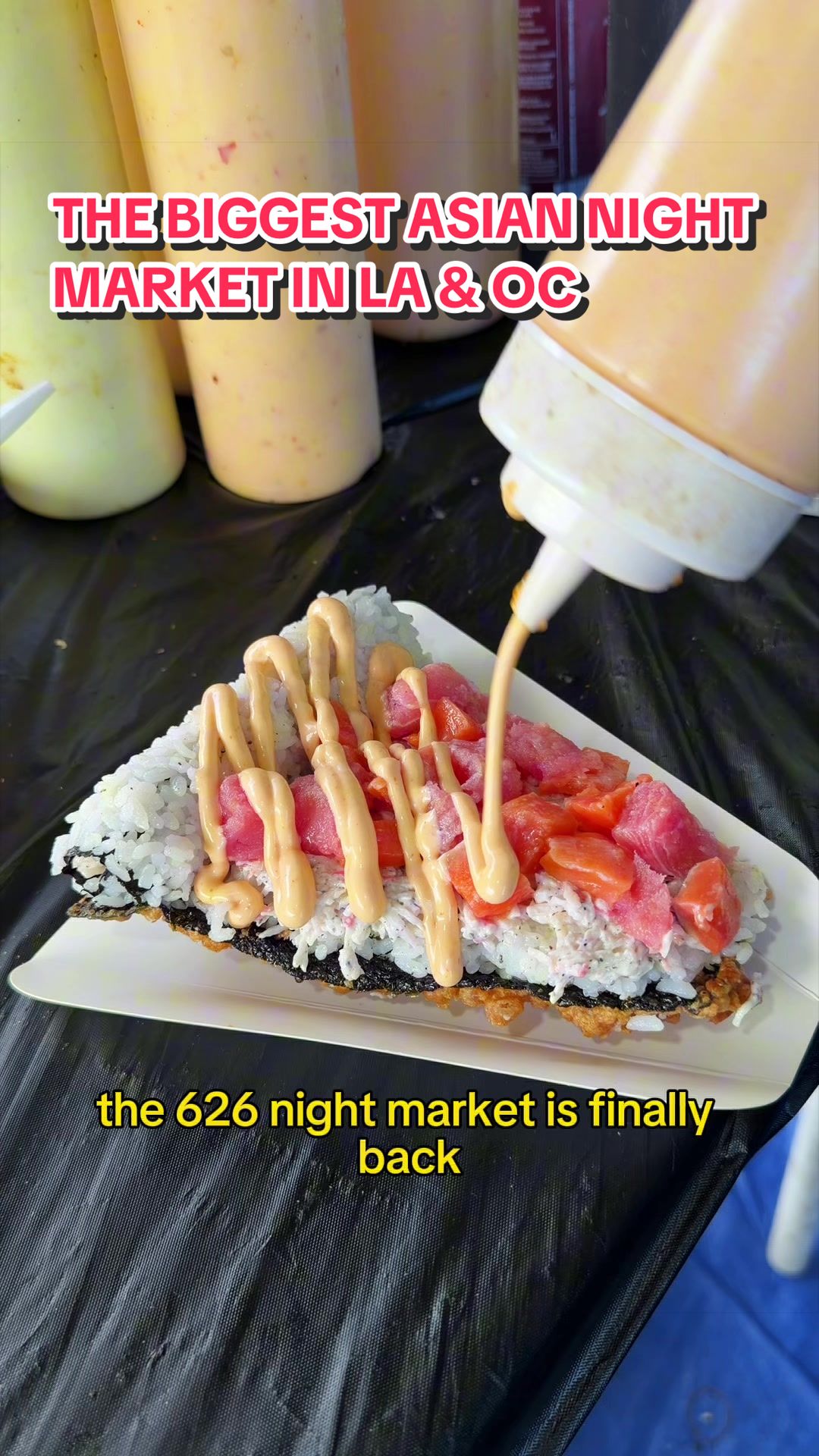
Then there are the places the review economy has not rated at all. Yum Long, a dumpling room where @nate_eatz points you at the Xiao Long Bao, the pork chop fried rice, and the cucumber salad — no rating, no review count in our data. 626 Night Market and Waterfront Bar & Grill, both @nate_eatz, both with no review numbers attached. I want to be honest that "no review count" partly reflects the limits of what we capture, not a proven zero. But the direction is the argument: these are places a creator has already covered and recommended specific dishes for, sitting in the discovery layer, while the retrospective star-and-review system has nothing to say about them yet. The creator got there first. That is the whole thesis in three restaurant names.
The middle band, and why it proves the mechanism
Between the 807-review establishment and the 8-review rumor, LA has a thick middle band, and it is the most useful evidence because it shows the handoff in motion rather than at the extremes.
Margaret sits at 3.9 across 151 reviews — a seafood grill @jacksdiningroom covers. Bistecca, an Italian steakhouse, 4.4 across 139, also @jacksdiningroom. Xarcuteria Adrià at 4.4 across 145. Sanamluang Cafe, Thai, 4.1 across 97, surfaced by @nate_eatz. Market Broiler at 3.9 across 80, @nate_eatz again, with lobster tails, steaks, and cioppino called out. These are places with enough reviews to be findable in the old system but nowhere near the four-figure gravity of Lawry's. They are legible but not settled.
Erewhon belongs here too, and it is instructive: 4.0 across 45 reviews for the specific location in our set, surfaced by @ignaciodipe with the Hailey Bieber smoothie as the pick. Erewhon is famous. Everyone in LA knows the brand. And yet the review count on this entry is 45, because fame in the TikTok layer and review accumulation in the Google layer are not the same currency and do not convert cleanly. A smoothie can be a cultural object with millions of views attached and still sit under 50 Google reviews at a given store. The two systems are measuring different things.
That is the mechanism. In LA the creator bench is deep enough that creators are covering the entire band at once — the 807-review institution, the 145-review mid-tier, and the 8-review rumor in the same week, by the same handful of accounts. @jacksdiningroom alone spans Lawry's at 807 reviews down to Miya Miya at 15. @nate_eatz spans Cravin' Crab Haus at 282 down to a dumpling room with no reviews logged at all. When a single creator's coverage stretches across four orders of magnitude of review count, the creator layer is not tracking the review layer. It is running independent of it, and in LA it is running ahead.
Why the save beats the star, and why it is worse in LA
The underlying reason is the same one that holds everywhere, LA just makes it loud. A Google review is a verdict. A TikTok save is an intention. The two artifacts answer different questions.
A review is retrospective and self-selected. You leave one after you go, usually because something was notably good or notably bad, and most diners leave nothing at all. That is why Miya Miya has 15 and Lawry's has 807 — not because one is fifty-three times better, but because one has had years and volume for the retrospective sample to build. The review corpus is a slow, backward-looking average.
A save is the opposite. When you save a creator's clip of the Xiao Long Bao at Yum Long, you are telling yourself you want to go. It costs nothing, it is private, and it happens before you have been. It is forward-looking. In a city with this much creator output, the forward-looking artifact accumulates far faster than the backward-looking one, which is precisely why the discovery layer outruns the verdict layer here. The creators generate intention faster than diners generate verdicts. In a slower city the two might stay roughly balanced. In LA, with the deepest bench in the corpus feeding the intention side, the balance is gone.
There is a real cost to that gap, and I do not want to pretend the creator layer is pure signal. A 5.0 across 15 reviews can curdle. A dumpling room with no verdict logged might be genuinely great or might be riding one good clip. The forward-looking layer is faster but noisier; the backward-looking layer is slower but settled. Both are true. The mistake LA makes, and the reason the split matters, is assuming the star average is still the primary system when for anyone under 35 in this city it demonstrably is not. They are scrolling, saving, and showing up at places Google has barely rated.
What LA tells you about where this goes
The implication is not that Google Maps is dead. Lawry's still has its 807 reviews and they still mean something. The implication is that in a deep-creator city, restaurant discovery has split into two parallel systems that no longer keep pace with each other, and the faster one — the creator-surfaced, save-driven, forward-looking one — is where the next restaurants actually enter the culture. By the time a place like Miya Miya or Dunsmoor accumulates the 300 reviews that would make it "real" to the old system, the creators who found it will have moved three restaurants down the block.
If you run a restaurant in LA, this is the number that should scare you and the number that should comfort you at once: you can have 15 reviews and a creator on your side and a line out the door, or 800 reviews and no creator and a dead Tuesday. The review count is a lagging indicator now. In this city it lags by years.
And this is the part where I say, briefly and in voice, what I am building. Your save folder inside TikTok is private, single-user, and impossible to search across creators. But in LA that folder is functionally your list of the next restaurants — the ones Google has not caught up to. If the save folder is the real discovery index in a city this creator-dense, it deserves to be a real product, with the place, the dish the creator pointed at, and the map attached. That is what GeoTok is for. Here is the one link, and then I am done.
On iPhone
Keep your restaurant ideas in GeoTok.
Save places from food videos and screenshots, then find them on your map when you want to go.
GeoTok Plus subscription required. Some guides are sold separately.
The reason I keep coming back to Los Angeles is that it is the cleanest proof of the thesis I have. Deepest creator bench, widest gap between what TikTok has surfaced and what Google has rated, and a set of real rooms — Miya Miya at 15 reviews, Dunsmoor at 8, Yum Long at none — that the creators found first. The verdict layer will catch up to them eventually. It always does. But in LA, in 2026, the intention layer is the one that already knows where you are having dinner next, and the star average is reading last year's news.
— Aleks, GeoTok, July 2026